
GARY NICHOLSON

Gram Parsons
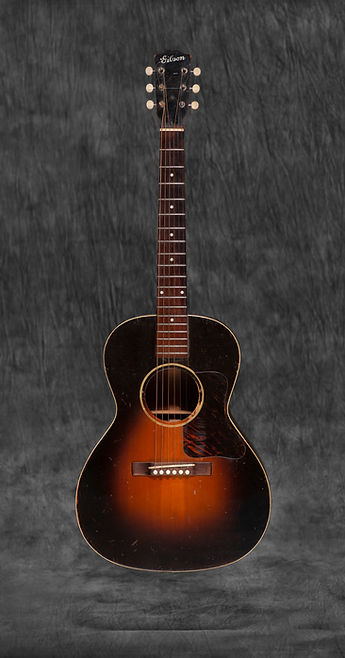
Guitar : 1936 Gibson L-OO
My musical tastes shifted dramatically in late 1969. “Sweetheart of the Rodeo” by the Byrds had me rediscovering country music. You can’t grow up in Texas without constant exposure, it’s built into the ether, but the British Invasion had consumed me for awhile. Then the blues that the Brit’s shined a light on took me over. With Clapton covering Freddie King’s “Hideaway” on a John Mayall record, I began to realize that the music I was loving the most was all around me. I saw Jimmy Reed first at the Dallas Trade Mart, Lightning Hopkins at the original Mother Blues, Mance Lipscomb at a taping at SMU, and Freddie King at numerous places, the first time at The Pit (at the Bronco Bowl). Blues music drew me in, and country music seemed corny and straight to me all through high school. My experience playing country music had only been the rare casual gig with some older guys (electricians and plumbers) at a VFW hall or the occasional low-grade beer joint around east Dallas with weekend players. The hippie country approach registered as cool with me. I had
never really considered how much country music had to do with the start of rock n roll. I became a fan of Buffalo Springfield, The Byrds, and especially The Band. “The Gilded Palace of Sin” by the Flying Burrito Brothers easily became a favorite record. There was a rocking vibe in their approach to country music, and it had a loose, not-so-great sonic quality that made it more real somehow. Some records just have a vibe that charms you, and that one did it for me and my bandmates. It wasn’t all slicked up like the country-pop music on the radio.
The Band had been on the cover of Time magazine, and they were calling this music country rock. It just felt like the right stuff to be playing at the time. I feel as though my love for the music of The Band set me up to like the Burritos. The songs that hit me right off were “Dark End of the Street” and “Do Right Woman” (co-written by my collaborator to be, the great Dan Penn). Then it was “Wheels” and “Sin City,” and who could resist “Hot Burrito #1”: a terrible title for a very soulful ballad. I heard the Burritos referred to as “Cosmic American”. Now it would fall into the catch-all genre “Americana”.
It is because of the great Dallas steel guitar player Larry White that we met Gram Parsons and moved to LA in August of 1970. I think of those few years as a very condensed movie when I consider all that happened in such a very short time. It all started on Saturday, July 27, 1970. Sneaky Pete Kleinow was the magical, innovative, fuzz-boxed, weird-tuning, Leslie speaker-using steel player with the Burritos. When they came to Dallas to play at the State Fair Band Shell, a co-bill with Big Brother and The Holding Company, Sneaky was interested in visiting the MSA steel-guitar factory. Larry was the guy chosen to give him the tour because he was playing an MSA steel and knew everything about them. Larry showed him around, and they talked steel-guitar talk about knee-levers and floor-pedals and tunings and pickups and such. Larry called me when they got back to the Holiday Inn and invited me to come and meet the band. I went right over and said hello to the guys. We told them how much we liked their music, and they invited our band to come to the show that night.
We had been playing three or four songs from their record, “The Guilded Palace of Sin”. We liked “Wheels”, “Sin City” and “ The Dark End of the Street”. The line up was Gram on acoustic, Chris Hillman on bass, Mike Clark on drums, Sneaky Pete on steel, and Bernie Leadon on Telecaster. I don’t know if they considered it a good night, or if was just a gig on the way to another gig, but we thought they were cool (although in true nightclub-musician mindset we were overly critical of how loose they were). Gram was not in good voice that night. The sound system was not what it should have been, and the sun was not down enough for the stage lights to have much effect. But what I got from that night was beyond their performance; it was the first time I’d seen some longhaired rockers like us playing country music, and they really meant it. I thought it was cool that Chris Hillman, who had already been a rock star with the Byrds, would choose to make this music. Gram had a vibe that felt honest and intentional, with reverence for the songs, not showy or phony overdone like a lot of local country entertainers around Dallas. And it was cool to see Sneaky doing his unconventional inventing of what later was labeled “hippie steel”.
After the show we went back to pay our respects, and as post-gig activities will evolve, Gram and his girl Gretchen followed us over to the house where our band had been rehearsing. We had amps and drums set up in the living room, and enough booze and drugs to keep us carrying on ’til sun-up. Gram just wanted to keep going. He had played the show that night, and his energy was up and fully fueled. Larry White’s command of the steel was grand entertainment for Parsons, who knew a lot of songs and kept ’em coming. Larry had been playing steel since he was preteen, and he knew all the country standards: kickoffs, endings, and signature licks for anything Gram could remember the words to. The later we played and the higher we got, the deeper we dove into a well of classics at four-thirty in the morning.
When the jam finally petered out, we lamented to Gram our situation of not being able to play country bars as long-hairs, and also not being welcome at rock and roll clubs because we were playing country music. He suggested we come to LA, where he believed we could find more opportunities, surely because Larry had impressed him so. By the time Gram finally left that morning, the birds were chirping and the sun was peeking in. He gave me his number and said to stay in touch.
Wes’ Uncle Jim was living in Hollywood. His invitation to stay at his place and the encouragement from Gram was all we needed. Two weeks later we were driving to LA in Wes’ mom’s blue Malibu, the trunk packed with Larry’s MSA steel, Wes’ Telecaster bass, our drummer Bobby Hibbitts’ snare, and my new-used 1963 Gibson ES- 335. Our friend Billy Wiseman was along to help drive, because he knew a girl in San Francisco. My Dad took me over to Wes’ to meet up with everyone for the trip. He gave me a twenty, and I climbed into the back seat. As we pulled away, Billy, our lead-off driver, turned up a bottle of Ripple wine. I knew my dad couldn’t have missed it, and I looked out the back window to see him shaking his head from side to side: the universal motion for…Wrong!
When we got to LA, Uncle Jim was there to meet us at a motel right on Sunset. He brought along an assortment of alcohol and drugs that astonished us. “I didn’t know what you guys were into, so I brought a little of everything”. Weed, uppers, downers, a case of Bud, jug of wine, fifth of Jack, vodka, gin. He apologized for not having any acid; he’d have to wait ’til tomorrow to score at his regular poker game in Gardena.
After we settled in for a day, we got in touch with Gram, and he said to meet him at The Palomino. When we got there he told me it was talent contest night, and our band should be contestants. We were a bit embarrassed to be in a talent contest ‘cause we were a working band. It probably wasn’t fair, but we won. We played one of our original songs “Once in a Great While”, that featured Larry on a steel solo. As soon as we came off the bandstand there were players who wanted to meet Larry, among them were Red Rhodes, Delaney Bramlett, and James Burton. Our grand prize was a fifty-dollar check (kept a copy).
Red Rhodes was an in demand steel guitar player and a member of Michael Nesmith and the First National Band. He was especially complimentary to Larry, and he liked our original songs. He generously invited us to stay at his place in Sherman Oaks for a while, sleeping in his kids’ bunk beds while his family was out of town. The drummer for that group, John Ware, came over to Red’s, and we played some. John later joined Emmylou Harris’ Hot Band. Wes and I were trying to fit in anywhere just to get something going. Larry and our drummer Bobby went on back to Texas after a week or so, but Wes and I decided to stay and see what could happen.
The Palomino was our main place to hang out, sitting in some and looking for what’s next. One night we ran in to Gram, and he invited us to follow him to where he was staying. He was driving fast in a little rag top sports car. Wes was barely able to keep up with him, winding through the hills with no idea where we were headed. Having never before seen an electric garage-door opener, it was magic when Gram pulled into the driveway. In the garage sat a bulked-up bald fellow with a long brown beard, slumped in a folding chair watching a small black and white TV. There was a .22 rifle, a shotgun, and a handgun within reach. Gram waved hello to the guy as we walked on in, acting like we knew what was normal in the Hollywood Hills.
We learned later that we were at Terry Melcher’s house, the home of his mother, Doris Day. Everything was white in the living room: white carpet, white grand piano, white fish in the aquarium. Though we were a bit awestruck, we settled in with some beers and weed and were passing a guitar around. Gram liked playing the big white piano and singing old gospel songs. We had been there for an hour or so when Terry arrived. Wes and I were sitting in the floor hippie-Indian style in front of the fireplace, and Gram was in the bathroom when Terry walked in right past his bodyguard. The moment Terry saw us, he was out the door, then right back in with the bodyguard holding the shotgun. Gram came out of the bathroom with a snort as Terry was hollering, “Who are these guys?” Gram held up his hands as if to make peace. “It’s cool man, these are just my friends from Texas.”
Tex Watson was one of the main killers in the Manson murders, of which Terry was the main intended victim because he had backed away from producing Charlie’s record. Wes and I looked like family members, with hair to our shoulders and Wes’ full black beard. When Gram mentioned Texas it must have hit a nerve. Terry shouted, “Get out of here now, and Gram, you’re no longer staying here. Everybody out!” He stomped back through the garage, jumped in his red two-seater and sped away. At the time, Wes and I had no idea who Terry was, even though he had produced the Byrds, the Beach Boys, and Paul Revere and the Raiders. We had heard about the murders but had no idea whose house we had followed Gram to. We were also unaware that the Manson murder trials were in session at that time, mid-August 1970. No wonder Melcher had a bodyguard.
Doris Day had encouraged Terry to move into her house after he told her about Manson’s scary antics, his brandishing of knives, and his zombie-like followers. When Terry mentioned to his mother that Manson had been to his house on Cielo Drive, she insisted that he get away from him and move to her place. So it could be said Terry’s movie actress mom saved his life.
Now that I have read the book “Chaos”, detailing the Manson murders, and watched the cable series “Helter Skelter”, it seems dreamlike and surreal that we were there. At the time, we just passed it off as some fella whose mom was a movie star got all freaked out that Gram had brought some friends over for a little jam. After Terry took off, Wes and I left immediately, and I only saw Gram a few times after that. I learned from friends that he was staying at a motel out in the desert a lot, playing some with a local band and doing a lot of drugs. By September of ’73 he was gone, a whole other story.